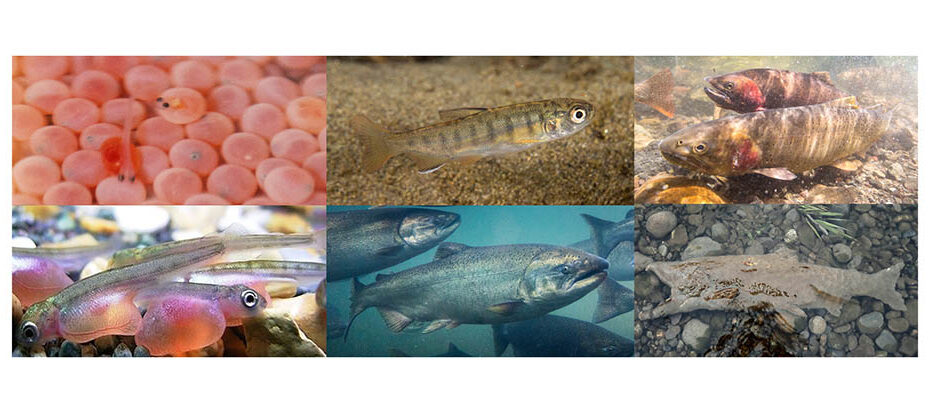
The journey of Pacific salmon is a riveting saga of resilience and metamorphosis. Sockeye, pink, chum, coho, and chinook salmon undertake epic odysseys that will ultimately cost them their lives.
This page is an introduction to the complex life cycles of Pacific salmon. Their journeys take them from freshwater streams and lakes to the ocean and back again.
Life Cycle of Pacific Salmon
The life cycle of Pacific salmon is an extraordinary journey, a series of transformations and migration. Though diverse in their specific life histories, certain fundamental stages are shared among Pacific salmon.
Under the Gravel: Eggs and Alevin
All salmonids begin life in freshwater streams, rivers, or lakes under gravel. Within fertilized eggs, embryos feed on yolk sacs. The embryos require oxygen, a sterile environment, and cool water.
After a period of weeks to months, they hatch as tiny alevin. Alevin remain under the gravel, as they are not competent swimmers. Their yolk sacks sustain them while they develop.
With all or most of their yolks consumed and winter coming to an end, the young salmon are ready to emerge.
Juvenile Salmon: Fry and Parr
Under the cover of darkness, salmon emerge from the gravel with the warming waters of spring. Now called fry, these tiny salmon have a fully function digestive tract. They must find safety and food.
The fry of some species of salmon will immediately migrate downstream to the ocean—particularly chum and pink salmon. Once again, this is under cover of darkness.
Ocean-type chinook salmon can migrate somewhat quickly to the ocean or remain in freshwater for up to a year. On rarer occasions, sockeye and coho salmon do this too.
Not all Pacific salmon rapidly head for saltwater after hatching. Several species remain in freshwater for at least a year before migrating to the ocean the following spring. This includes the river-type chinook (spring and winter-run), most coho and sockeye, and all masu salmon.
Salmon fry in freshwater act similarly to trout and char fry. They feed on zooplankton while hiding from predators like larger fish, birds, and otters.
As salmon fry grow, they develop into the trout-like parr stage. The diet shifts to larger organisms like aquatic invertebrates and terrestrial insects. Salmon eggs and carcasses are also important food sources for juvenile salmon in freshwater when available.
Young salmon in rivers and lakes develop more spots, and their parr marks get bigger. Salmon parr are camouflaged by their markings and golden-yellow coloration.
Preparing for Saltwater: Salmon Smolts
Pacific salmon undergo dramatic changes to transition from life in freshwater to saltwater. Salmon at this stage are called smolts.
The shift from parr to smolts typically unfolds in spring. Longer daylight and warming waters act as a trigger for the juvenile salmon.
Smolts transform physically to prepare for marine life. Their parr marks fade and develop blue-green backs, silvery sides, and a white belly. Smolts become slimmer and elongated. New teeth on their tongue and gums enable them to catch bigger fish.
Significant internal adaptations also occur for saltwater survival. Gills are modified for salt regulation, and kidneys adjust to manage salt balance and increased water intake. These changes are coupled with metabolic and endocrine shifts, preparing smolts for their ocean journey and storing energy. The immune function of smolts decreases slightly during this phase.
As these transformations take place, smolts migrate downstream. Pink and chum salmon skip this stage, migrating to the ocean immediately as fry instead.
Pacific salmon species are not uniform in their use of estuaries as smolts. Smolts that feed and adjust in estuaries experience rapid growth. Regardless, nearly all salmon smolts leave their local estuary by mid to late summer as juvenile adults.
In the Ocean: Juvenile and Adult Pacific Salmon
Salmon grow and mature in the ocean as juvenile adults. Their time at sea varies by species, age of ocean entry, and marine conditions. This phase is the least understood of their lifecycle, but salmon undergo significant growth in the ocean.
Many salmon travel great distances in the North Pacific while they feed and grow. This is especially true of chum salmon but also sockeye. Coho, pink, and chinook salmon don’t travel as far on average. However, there are plenty of exceptions.
Close to maturity, salmon eventually migrate back to their home rivers. They have incredible navigational abilities aided by a keen sense of the earth’s magnetic field and their location within it. Closer to home, salmon also use sight, smell, and memory to find their way to the stream where they were born.
Return to Freshwater to Spawn
The trek upstream is perilous for salmon. They navigate back to their birthplaces to reproduce, often covering hundreds of miles and filled with daunting obstacles. Some exceptional individuals even travel over 1900 miles (3000 km) on their upstream spawning migration.
Salmon often travel to their exact place of birth to spawn. They select gravel with adequate size, oxygen, flow, and depth with little sedimentation. Mature female salmon compete for the best sites.
Female salmon dig nests (redds) in the streambed, while males battle for access to the female. The largest, strongest male usually wins, but he also must successfully court the female. When the female releases her eggs, the male releases sperm (milt) to fertilize them. It’s not uncommon for other smaller males to sneak in and fertilize eggs.
After releasing her eggs, the female buries them with gravel. Female salmon often spawn multiple times in different pockets dug out of the redd. When all of her eggs are spent and buried, she will remain and defend the nest from other females that might dig up her eggs to form their own redds.
With the exception of masu salmon, all Pacific salmon die after spawning. During their final freshwater migration, salmon do not eat. Fat reserves fuel their spawning migration until they eventually succumb to exhaustion. In this regard, salmon are semelparous, meaning they only reproduce once before death.
Salmon Carcasses: Life After Death
Pacific salmon play vital ecological roles throughout their lifecycle. And this continues even after they die.
Salmon achieve the vast majority of their size at sea. Their marine-derived nutrients make a significant contribution to nutrient-poor streams and surrounding terrestrial landscapes.
Salmon carcasses and unburied eggs offer direct sustenance to other salmonids and fish species, invertebrates, birds, bears, and many other animals. Phytoplankton and zooplankton in lakes also utilize the nutrients. And the usefulness of salmon carcasses isn’t just limited to aquatic ecosystems. Tree growth in riparian zones also benefits from fertilization via carcasses.
Fisheries greatly reduce the amount of salmon returning to freshwater to spawn, resulting in fewer carcasses. This has hurt the long-term productivity of ecosystems with populations of salmon.
The Complex Lives of Pacific Trout and Char
This article is about the life cycles of Pacific salmon, but Pacific trout and char deserve honorable mention. Though closely related, trout and char exhibit an array of life histories distinct from their semelparous salmon relatives.
Iteroparity species like rainbow and cutthroat trout, bull trout, and dolly varden can survive spawning and will do so over multiple years. They also adapt various strategies not commonly seen in Pacific salmon, like resident, fluvial, and adfluvial life histories.
Their complex life cycles will be explored further in future dedicated articles.
The End is Also the Beginning
From the headwaters of rivers to the expansive Pacific, salmon embody a relentless drive and adaptability that is as poetic as it is pragmatic.
Along their journey, they nourish many animals, including humans. Pacific salmon are ecological cornerstones that shape the health of waterways across western North America and beyond.
Surviving predation, environmental changes, and human impacts make their successful return to spawn all the more miraculous. By studying these species, we gain not only insight into their lives but also lessons on resilience and the interconnectedness of all living things. Out of respect, let’s protect the diverse and dynamic habitats Pacific salmon call home.