
The chinook salmon is the largest and most powerful Pacific salmon. It plays a vital role in the food webs of the North Pacific. But it’s also delicious and must elude many predators, including humans, throughout its complex life journey.
This article dives deep into the life cycle of chinook salmon. Find out what it eats, where it lives and spawns, how big it gets, and much more.
Overview of Chinook Salmon
Chinook salmon, or king salmon, are an anadromous fish originating from the North Pacific. They’re born in freshwater, eventually migrates to the ocean, then returns to its birth stream to reproduce.
Like most Pacific salmon species, chinook are semelparous, meaning they die after reproduction.
Chinook salmon exhibit a wide diversity of life history strategies. There are two broad categories of king salmon: ocean-type and stream-type. Within these broad categories, there are also spring, summer, fall, and winter-run kings. These types of king salmon will be discussed in more detail later.
Most chinook spawn in the fall, but spawning has been recorded in every month of the year somewhere in their range. Introduced populations can develop new behaviors. In Lake Superior, chinook derived from fall-spawning stocks now spawn in spring to match the warmer flow of tributaries.
Species and Name: Chinook, King, Tyee
The scientific name for chinook salmon is Oncorhynchus tshawytscha. Tshawytscha originates from the common name chavycha, which comes from the Koryak languages of the Kamchatka Peninsula. It is pronounced “cha-vee-cha.” Oncorhynchus tshawytcha is one of the six species of Pacific salmon. It was first classified in 1792 as Salmo tshawytscha. It was later reclassified into the genus Oncorhynchus in the late 19th century.
King salmon, or “kings,” is a common name for chinook in much of North America.
Tyee salmon is a fisherman’s term for especially large chinook (30lbs +). It’s derived from the Nuu-chah-nulth language of Vancouver Island, meaning “chief.”
Other localized common names for chinook include spring salmon (mainly in British Columbia), blackmouth (Puget Sound), and Quinnat salmon (New Zealand).
Range and Abundance of Chinook
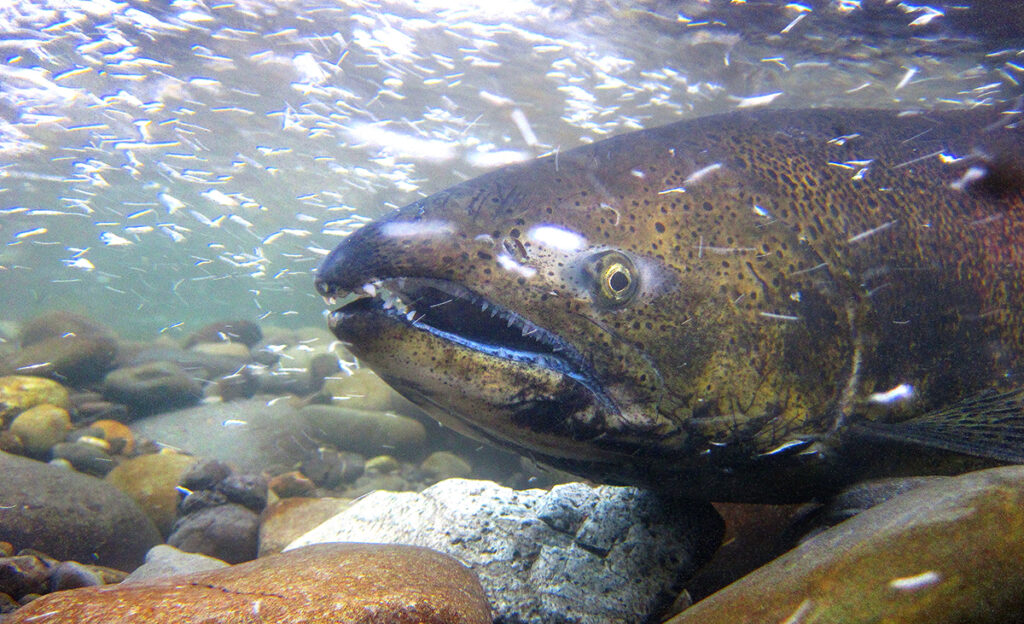
Chinook salmon are the least abundant Pacific salmon. However, adult kings often outnumber adult anadromous rainbow and cutthroat trout where they cohabitate.
This remarkable fish historically inhabited a wide range that spans both sides of the North Pacific Ocean, with greater abundance in North America than in Asia. There are also populations of king salmon inhabiting rivers draining into the Arctic Ocean. They also hold the southernmost range of any Pacific salmon species in the eastern Pacific.
North American King Salmon
In North America, the northern edge of the chinook salmon’s range are Point Hope and the Kotzebue Sound in Alaska (Arctic Ocean). Its southern distribution extends to the Ventura River and upper San Joaquin River in California.
The chinook is a fish of big rivers, and historically, its major populations were (from south to north) in the Sacramento-San Joaquin, Klamath, Columbia, Fraser, Skeena, Kuskokwim, and Yukon River Basins. The Columbia River basin was once the heart of king salmon abundance. Spawning runs reached 4 to 6 million fish. Their combined biomass was up to 100 million pounds. In the Sacramento-San Joaquin basin, up to 2 million chinook once returned to spawn.
Chinook in Asia – Western Pacific
In the Asian/Western Pacific region, the chinook has a narrower range. It’s most abundant in Kamchatka. But this salmon also inhabits the Amur River and the continental Sea of Okhotsk region in the south. There may also be modest hatchery production from Hokkaido, Japan.
The northern extent of chinook salmon in Asia extends to the Anadyr River in Russia. There may also be hatchery-origin populations as far north as the Palyavaam River of the East Siberian Sea.
King Salmon Introductions
Chinook have been introduced to watersheds across the globe. The most famous was in the Great Lakes of North America. Chinook adapted to the exclusively freshwater environment and now have self-sustaining populations. The Great Lakes now have widespread natural reproduction in tributaries. But overall abundance remains dependent on hatchery stocking.
King salmon were also transplanted to Argentina and New Zealand. Self-sustaining populations in both countries are well-established. Argentina is now well-known for producing massive chinook. New Zealand’s chinook salmon originated from the McCloud River in California. Eggs were first shipped there in 1875. By 1907, adult chinook were observed returning from the sea. They now sustain runs in several South Island rivers.
In Chile, chinook are raised commercially in marine pens. Escapees have reproduced in rivers like the Rio Simpson. It’s uncertain whether these will become fully self-sustaining.
Chinook Salmon Size
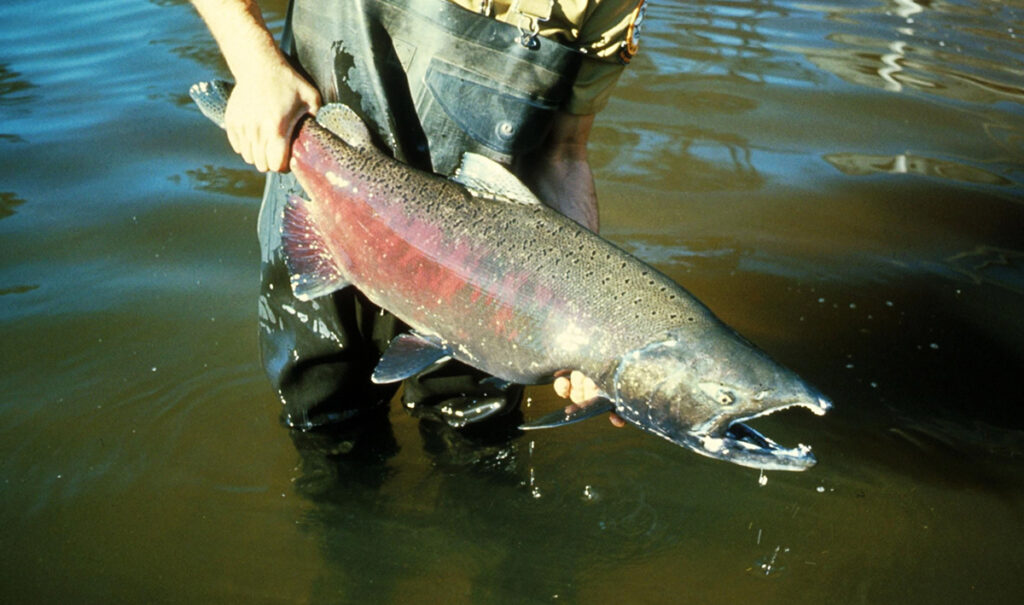
Chinook are the largest Pacific salmon and Oncorhynchus species.
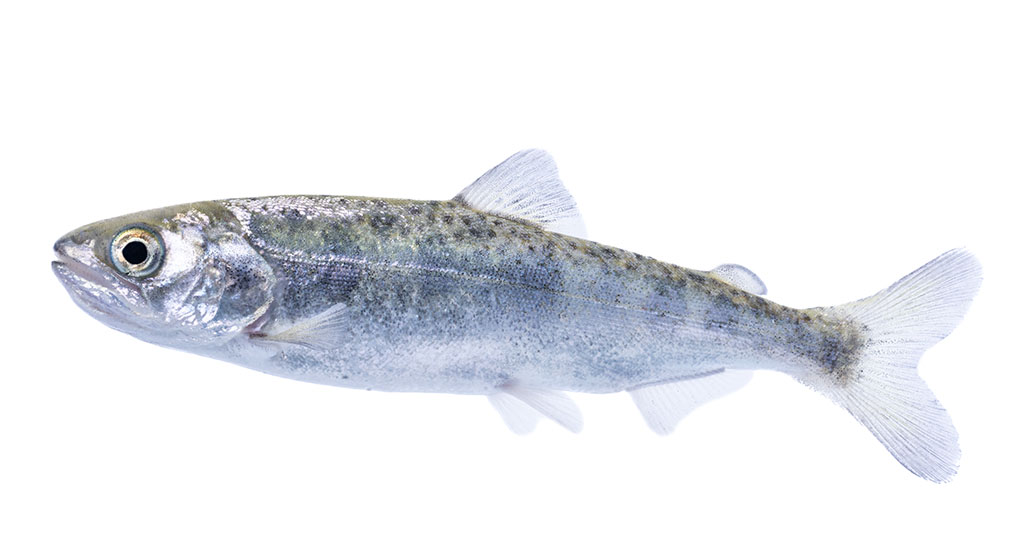
As a fry, king salmon average between 1.3 and 1.5 inches (33 mm to 37 mm) in length. Though relatively small, this is larger than other Pacific salmonids.
Their large relative size continues into adulthood. The average size at maturity varies based on the watershed, but a range of 24 to 36 inches (61 to 91 cm) in length is common. The average weight of adult chinook salmon falls between 10 to 50 pounds (4.5 to 22.7 kg), though a king over 30 pounds is considered large today.
The current IGFA all-tackle world record king salmon is 97 lb 4 oz (44.11 kg), caught in the Kenai River, Alaska, in 1985. The world record for the longest chinook is 3 ft 10 in (116 cm).
Surprisingly, chinook salmon grow larger than this. In 1946, a commercial trap in Petersburg, Alaska, captured a gigantic fish weighing 126 pounds! That 126-pound fish remains the largest verified size. Some unconfirmed reports suggest kings reaching 135 pounds and 60 inches in length.
In the Great Lakes, the largest on record weighed 47 pounds 13 ounces. It was caught in Lake Ontario’s Salmon River in 1991.
King Salmon Appearance
Chinook salmon are a dynamic species with an appearance that changes dramatically through their life cycle. As it travels from freshwater to saltwater and back, chinook change colors to adapt to their environment.
Juvenile King Salmon
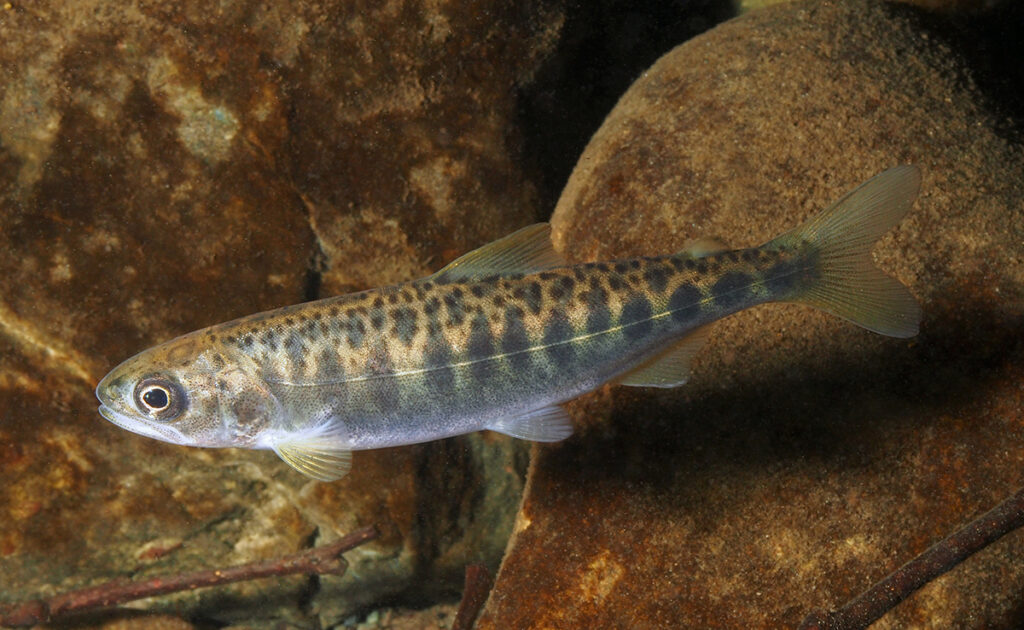
Juvenile chinook have olive to brown backs and white bellies. Large parr marks, plus spots on their backs and tails, help them blend into their environment, acting as camouflage.
Juvenile chinook salmon superficially resemble coho salmon, rainbow trout, and cutthroat trout. Each of these species have large parr marks, but on chinook, they are even across the lateral line and usually wider than the space between. They also tend to have deeper bodies overall.
Chinook juveniles can also be distinguished from similar species by their fins. The center of the adipose fin is clear (unlike coho). Chinook also have a black leading edge on their dorsal fins. And the anal fin of chinook isn’t sickle-shaped (like coho) and has a longer leading edge than the base.
Ocean Phase Chinook Appearance
Once chinook enter the marine environment, their appearance changes dramatically.
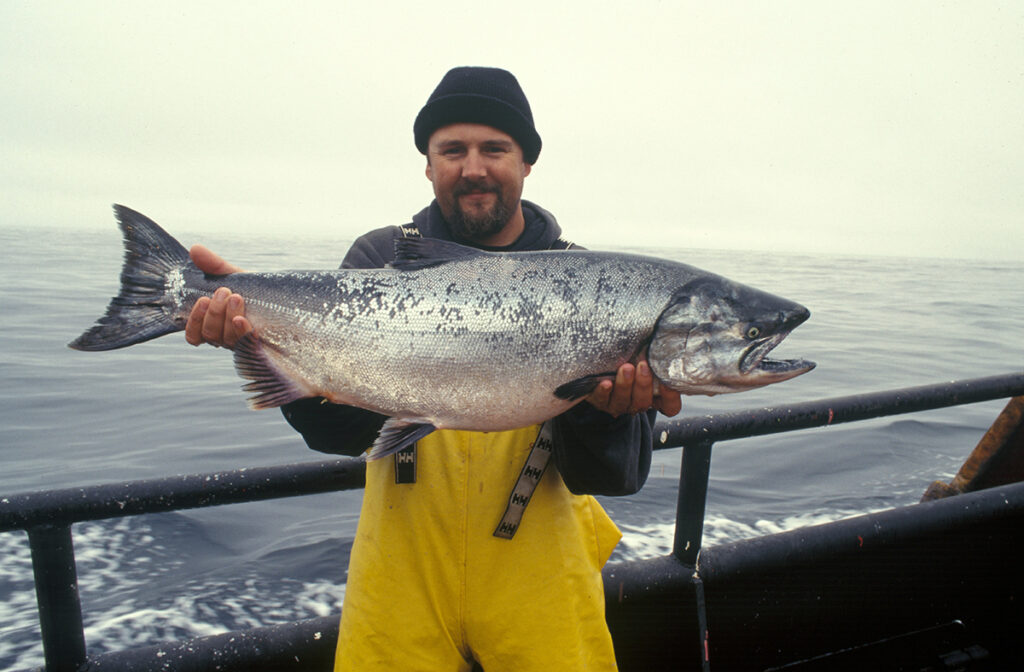
Parr marks begin to fade, though the spots remain on their backs, dorsal fin, and the lower and upper tail lobes. Chinook salmon turn a bright silvery color with bluish-green backs. They also have a black gum line. In the ocean, chinook salmon display brilliant silver sides.
King Salmon reach their maximum size by the end of their ocean phase.
Mature King Salmon Appearance
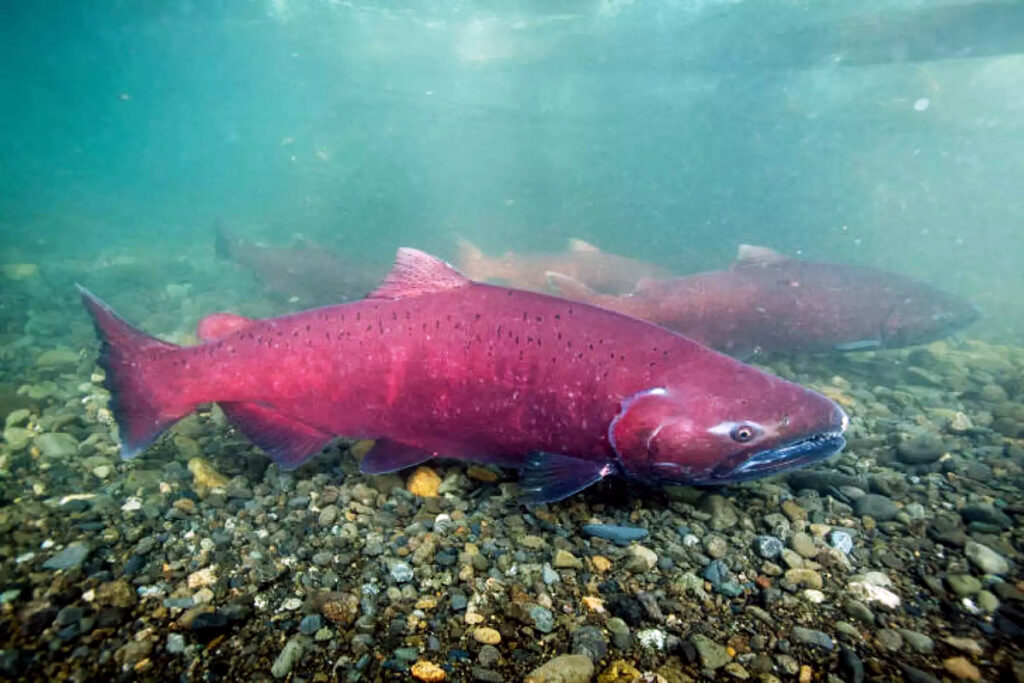
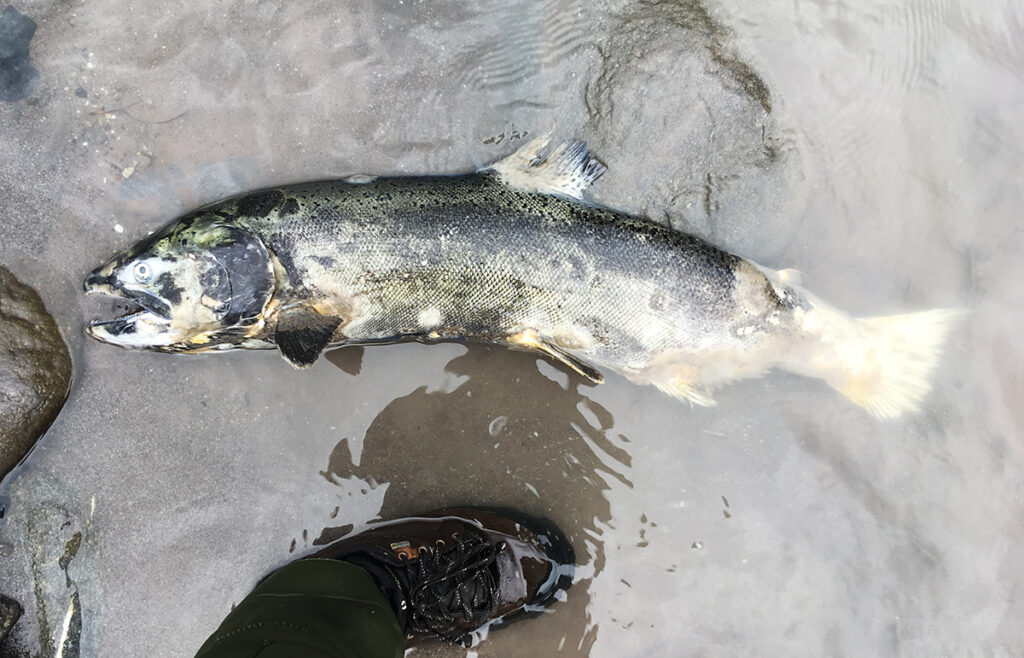
Chinook undergo another rapid appearance change in their spawning phase, though their transformation is less dramatic than pink, chum, or sockeye salmon. Upon entering freshwater, chinook salmon turn darker in color. Their jaws also become elongated, especially in males. Males also often develop a kype, large teeth, and a hooked upper jaw. Females will often display a torpedo-shaped body.
The color of mature king salmon varies by watershed. In general, chinook further south tend to be more olive and brown. Red-colored chinook are more common in the north. Toward the end of their life cycle, some chinook turn very dark, even black.
The King Salmon Life Cycle
Chinook salmon have a complex life cycle. They are born in gravel nests in freshwater streams. Then, they migrate to marine environments where they transform and grow. And they finish their lives by returning to their natal streams to reproduce. Their life cycles complete, king salmon succumb to exhaustion and die.
Early Life History: Eggs and Alevin
Chinook start life as eggs (roe) buried in gravel in streams and rivers. There are thousands of eggs in each nest (redd). Chinook hatch as alevin having large yolk attached. They remain in the safety of the nest until their yolk is mostly gone, then emerge as tiny fry.
The amount of time before emergence depends on the water temperature. Colder water (<40F) means slower development and incubation lengths of up to 200 days. On the warmer end of the spectrum (57F), chinook emerge from redds as soon as about 40 days. In general, chinook emerge from gravel in late winter to spring.
Ocean-Type and Stream-type Chinook Salmon
Juvenile king salmon have two patterns of freshwater residency: ocean-type and stream-type.
Ocean-Type Chinook
Ocean-type chinook spend little time in freshwater. Some fry migrate to saltwater immediately after emergence, while others may remain in rivers for up to a few months. Ocean-type chinook often slow down in estuaries to feed. They spend several weeks or more there before moving out to sea. Ocean-type fish grow rapidly and develop widely spaced circuli.
Ocean-type chinook are found south of Alaska. They tend to spawn and reside in the lower reaches of rivers.
Spring-Type Chinook
On the other hand, spring-type chinook spend an entire year in freshwater before migrating to the sea in the spring. They grow more slowly than ocean-type chinook, as streams and rivers are less productive than the ocean. Their scales show closely spaced circuli in the first year. They migrate past estuaries quickly and begin feeding in coastal and offshore waters.
In North America, the spring-type life history is the only kind utilized in Alaska and parts of northern British Columbia. Further south in their range, stream-type chinook spawn and reside inland at higher elevations.
There’s overlap of both life history forms of king salmon, with many rivers having both ocean-type and stream-type fish.
Chinook Salmon in the Ocean
Chinook feed and grow to enormous sizes in the ocean. They migrate to wherever they can find food. In California, this is off the coast. Chinook salmon in Oregon, Washington, British Columbia, and eastern Alaska typically travel to the Gulf of Alaska. And in western Alaska, chinook tend to migrate to the Bering Sea.
Kings enter saltwater as smolts and transform their appearance to adapt to the marine environment. Their parr marks fade, and scales become silvery.
Juvenile fish utilize eelgrass and seaweed for security and foraging habitat before heading to offshore waters. Their preferred ocean habitat includes cool, nearshore waters on the continental shelf. Juveniles often feed in regions rich in copepods and other plankton. Small fish and crustaceans are also on the menu.
Chinook grow rapidly in the ocean. Up to 98% of their body mass is gained during this phase. As they mature, their diet shifts to fish, squid, and large crustaceans. Herring, smelt, and sand lance are key prey.
Chinook spend between one and five years in saltwater before migrating back to rivers to spawn. A few individuals remain at sea even longer, but the most common range is from two to four years.

Return to Freshwater and Spawning
Close to maturity, chinook migrate towards their natal river using acute homing instincts. A few will stray into other rivers and streams, but most venture close to the location where they were born. Straying maintains gene flow across populations.
Chinook salmon stop feeding in freshwater and undergo a radical transformation. Their stomachs shrink to make room for eggs or milt. This internal shift makes feeding impossible. Their silvery color fades into darker reds and browns. The jaws of chinook also become elongated, and males often develop a kype and large teeth.
Before spawning occurs, mature king salmon prefer deeper and faster-moving water than other Pacific salmonids. Fishermen sometimes refer to this habitat as “king water.”
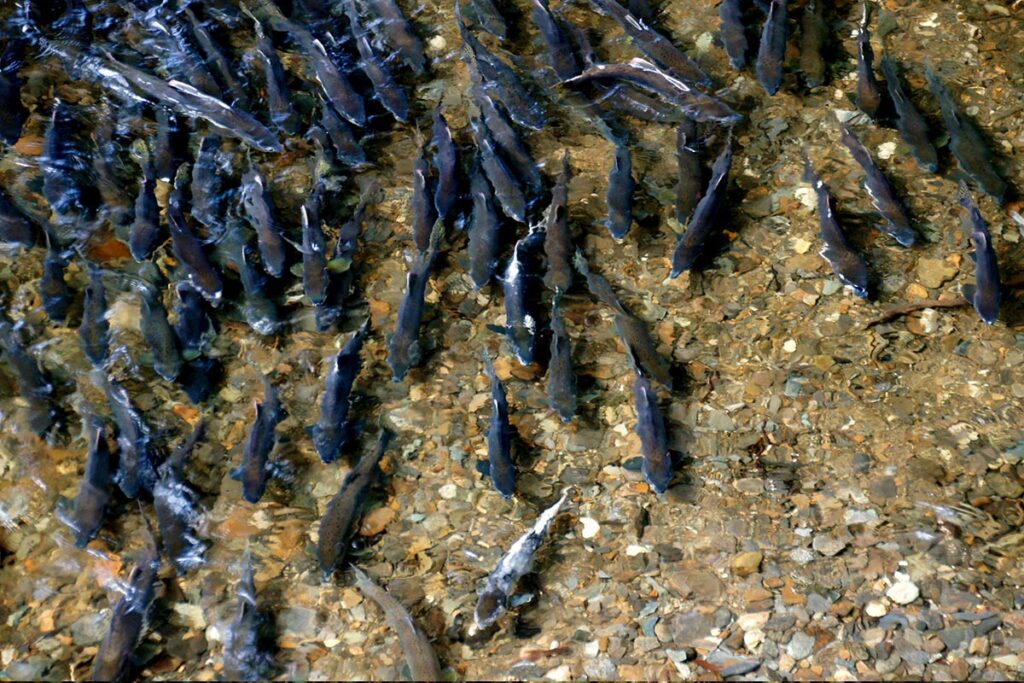
Males battle for reproductive access to females, and female chinook vie for the best spawning sites. Dominant males get the best access to females. But other satellite males and jacks on the periphery will sneak in to fertilize released eggs.
Female chinook salmon release their eggs into a series of pockets within their nest. After releasing eggs into the first pocket, it is filled, making the next one.
Males time the release of milt to fertilize the eggs. These spawning events are sometimes with the same males and sometimes not. After all her eggs are gone, the female chinook guards the nest against other females. Eventually, her strength fades, and she drifts downstream to die.
Male chinook spawn as many times as they can before they perish.
Ideal Chinook Salmon Spawning Habitat
Chinook are big fish, and that correlates with their spawning habitat.
They prefer medium to large rivers and nesting sites with clean, cold, and oxygen-rich water. Sediment will also be absent to avoid smothering and killing eggs. The gravel size chinook chose is also larger than other Pacific salmonids.
They also spawn in intertidal areas where stream mouths meet the sea. Some introduced populations even use lakes and spring-fed creeks.
Stream conditions drive timing. In some areas, spring-fed systems delay spawning until warmer temperatures arrive.
When do King Salmon Spawn?
King salmon typically spawn from late summer to early winter. However, depending on the run type and specific watershed, spawning may occur any month of the year.
Most king salmon spawn in fall. But spring, summer, and winter runs also exist. The Sacramento River has all four. The Columbia River has three.
Run timing and location are linked. Winter-run fish enter in January and spawn in spring. Summer and fall fish enter close to maturity and spawn soon after.
Seasonal Runs of Chinook Salmon
Chinook salmon enter freshwater to spawn at different times of the year. Their four distinct spawning runs have distinct life cycles and timing for spawning. Chinook exhibit spring, summer, fall, and winter-run life histories.
Spring chinook typically enter freshwater in the spring and early summer. They spawn that fall or winter.
Less time is spent in freshwater by summer and fall chinook. They enter close to maturity during the summer and fall and spawn shortly after.
Winter chinook enter freshwater from winter to spring and spawn in the summer.
Different runs often coexist in the same river system. Each run has distinct migration and spawning behavior. In the Columbia Basin, spring, summer, and fall runs each contain subgroups. Some fish spawn high in tributaries. Others remain in the mainstem. The Nanaimo River in British Columbia also has three races of chinook. They differ by how long juveniles stay before migrating. Some leave early. Others overwinter.
Chinook Diet and Feeding Behavior
The diet of king salmon varies depending on its size and life history stage.
Young chinook salmon in streams feed on invertebrates, including drifting aquatic insect larvae, amphipods, crayfish, and worms. Terrestrial organisms, eggs of other salmonids, and even mature salmon carcasses are also consumed when seasonally available.
Ocean-dwelling king salmon prefer cooler near-shore waters on the continental shelf, where they find ample food sources. In intertidal areas, young chinook feed on fish larvae, amphipods, and insects. Juvenile chinook also often congregate in regions abundant with copepods and the phytoplankton that sustains the copepods.
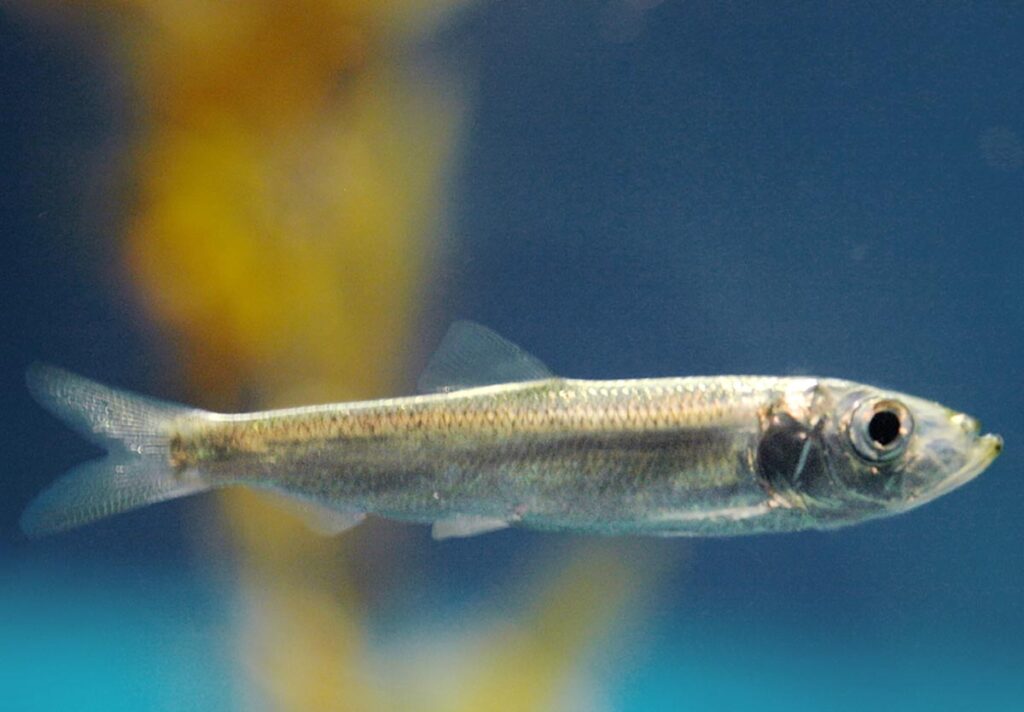
As Chinook salmon mature, they begin to feed primarily on fish including herring, smelt, and sand lance. Squid, krill, and crab larvae are also important food sources for marine chinook.
Up to 98% of a king salmon’s total growth happens at sea.
Upon entering freshwater for their spawning migration, king salmon cease eating. At this point, both males and females are focused solely on their reproductive mission.

King Salmon Declines
Wild chinook populations have declined sharply. Historic centers of abundance like the Columbia and Sacramento Rivers now depend heavily on hatcheries.
The decline has many causes. Poor ocean conditions are one culprit. Ocean changes in the 1990s briefly improved productivity. But warming waters and food web shifts continue to harm survival.
In freshwater, chinook declines have been driven by various combinations of the 4 Hs: harvest, hatcheries, hydropower, and habitat degradation.
Overharvest of chinook significantly reduced past populations of chinook. Overharvest isn’t as large of an issue today in some regions, however, bycatch in other fisheries like Alaskan pollock (Filet-O-Fish) have been destructive to chinook populations, as well as many other species.
Habitat degradation is a growing problem for chinook and other species of salmonids. This includes logging, mining, polluted runoff, and development. Streams have been simplified, sped up, warmed, and polluted. Habitat degradation is difficult to repair, and recovery is often a slow process.
Early West Coast North American hydro projects lacked fish passage and led to the extinction of countless local runs of chinook by blocking access to spawning grounds. Fish passage is more common today on dams, but more often, the lack of fish passage remains and is mitigated by hatchery production. This has led to other issues negatively affecting chinook.
Early hatchery programs ignored diversity. Mixed stocks broke down reproductive isolation and erased local adaptations. Hatchery practices have improved significantly but still pressure natural origin fish by reducing available food in streams and the ocean.
Some chinook runs are now protected under the Endangered Species Act. But even today, wild fish are only a small part of total returns.
Respect for the King Salmon
With its massive size and strength, the chinook is truly the king of Pacific salmon. Its complex life histories touch many ecosystems, where it plays a prominent role as a keystone species.
Today, this species faces many challenges, both man-made and natural. As humans, we can be a force for good and help the king salmon. Awareness of the chinook salmon and its life cycle is the first step. Thank you for taking the time to learn a little about this fascinating fish.